
Stop shipping heavy machinery to make a point.
Interactive 3D showrooms, product configurators and augmented reality that let an industrial buyer explore what you make, at true scale, from a browser — and qualify themselves before a rep ever picks up the phone.
This is what your buyer sees.
An interactive assembly with a hotspot on every component. Nothing to install, nothing to book, no plane ticket. Play it, or expand it to full screen.
Delivered through an agency partner for a North American manufacturer.
A spec sheet cannot answer the only question that matters.
“Will this work in my plant?” A PDF cannot answer it. A photograph cannot answer it. A site visit can, but it costs weeks and a plane ticket, and most buyers will not ask for one until they are already fairly sure.
Three formats. Same job.
Let the buyer answer their own question, and capture what they did while they were answering it.
Product configurators
Every variant, option, accessory and consumable, assembled live in the browser. Invalid combinations are impossible to build, so what lands in your inbox is always quotable.
Digital twins
A line, a cell or a whole facility as an interactive model. Used for sales, for operator training, and for remote commissioning when getting an engineer on site is not practical.
Augmented reality
The buyer places your equipment on their own floor, at true scale, through a phone camera. Clearances, footprint and access become obvious in seconds.
Real showrooms, already shipped.
Four from the portfolio, captured exactly as your buyer sees them. Every blue dot is a hotspot — open it for a spec, a part number, a short video or a link to buy. No plugin, no app, no download. It runs in the browser they already have open.
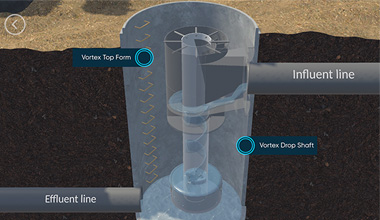
Stormwater vortex drop shaft
A below-grade concrete structure cut open in the browser. Influent line, effluent line, top form and drop shaft are each a hotspot, so a municipal engineer reads the flow path without a section drawing.
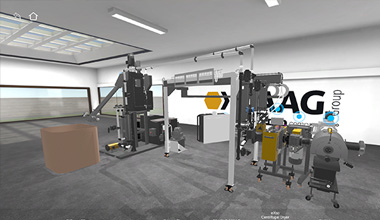
Pelletizing and drying line
A full plant-room walkthrough. Every machine on the floor is clickable — centrifugal dryer, feed hopper, control cabinet — so the buyer can walk a line that has not been installed yet.
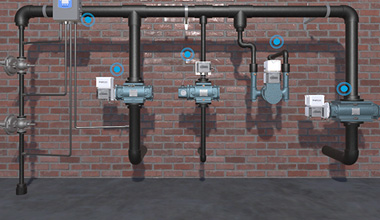
Rotary gas meter and regulator set
A wall-mounted metering assembly where each meter, valve and actuator opens to its own spec. Replaces the page of the catalogue nobody reads.
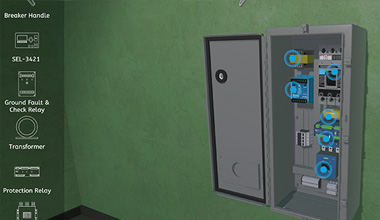
Protection relay and switchgear panel
Cabinet interior with the breaker handle, protection relay, transformer and ground-fault relay called out by part number. The kind of detail a distributor usually has to explain on a call.
Or put it on their floor.
The same asset, launched in augmented reality from the browser they already have open. No app, no download, no sales call first. Pick a model, tap View in your space on a phone or tablet, and a full-size machine lands on the floor in front of them.

This model could not be loaded right now. Try another one, or get in touch and we will send you a direct link.
Open in Safari on iPhone or iPad, or Chrome on Android, to launch AR. On a desktop you can still rotate, zoom and inspect the model. Everything is at real-life scale — pinch to scale it down once it is placed.
Client work: Romet models provided and owned by Romet; MAAG models provided and owned by MAAG Americas. Models under Other industries are public demonstration assets, shown to illustrate how the same technique carries across product categories. AR technology by TAPQUAD® Inc.
Scoped, fixed, and dated before we start.
No open-ended discovery phase and no hourly drift. We scope, quote a fixed price with a launch date, and hold it.
- Week 1 — scoping call, CAD and reference intake, options matrix agreed
- Weeks 2–3 — modelling, optimization for the browser, interaction build
- Week 4 — CRM wiring, optional 1Link® instrumentation, review and launch
- After — assets and source handed over; optional support retainer
It works alongside what your team already runs.
The showroom is not a closed system. With 1Link instrumentation you get real engagement data — which campaign brought the buyer, what they opened, how long they stayed — in a form you can use next to HubSpot, Salesforce, Zoho or Microsoft Dynamics. Pushing configurations directly into a CRM is custom work, scoped and quoted separately.
Ship it measured, if you want it measured.
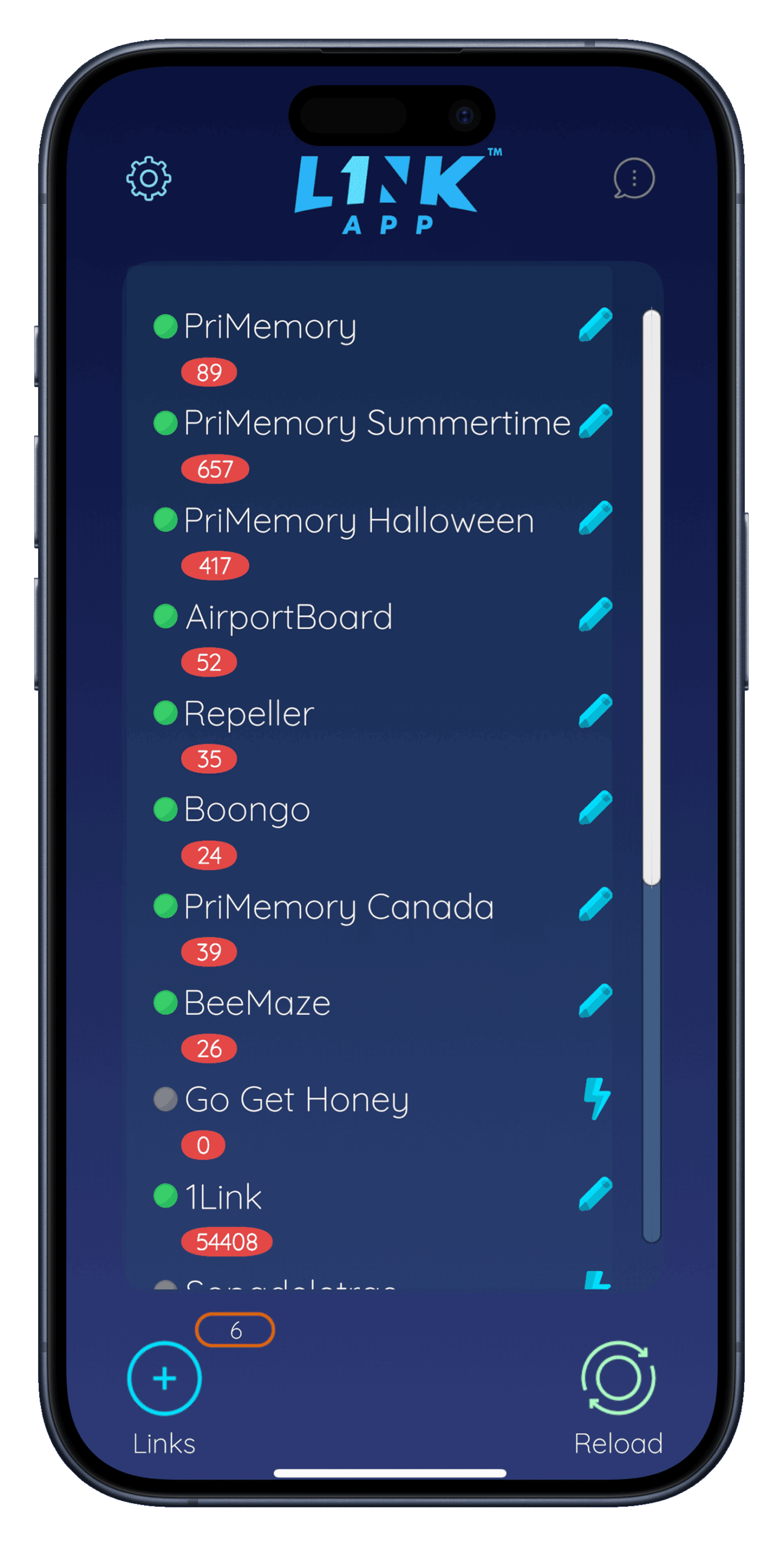
1Link® can be wired into any showroom we build, on request. You get real engagement and attribution data — which campaign, which buyer, which configuration, how long — so the investment defends itself at budget time instead of relying on your word. Already have an active 1Link® subscription? We instrument the build against your existing account instead.
When it ends, you keep it.
Most of this category rents you the experience. The platform hosts the models, and the showroom works for exactly as long as the invoice is paid. Ask what happens on the day you stop, and the answer is usually that it goes dark.
The assets are yours
Models, textures, materials and source are handed over at the end of the engagement, in open formats. Not a licence to view them. The files themselves.
No hostage clause
There is no subscription that has to stay alive for your showroom to keep working. If you stop working with us, the thing you paid for is still yours and still runs.
Portable by design
Built on glTF, USDZ and standard web technology rather than a proprietary player, so another studio can pick it up without starting from the beginning.
Two questions worth putting to any vendor before you sign: if we stop paying, what happens to the models — and can we take them somewhere else? Much of the platform tier cannot answer yes to both, which is why the question is rarely raised in their material.
Straight answers.
How much does a 3D showroom or digital twin cost?
Pricing is set per project, because scope drives everything: how many products, how many configurable options, whether we are modelling from CAD you already have or building from scratch, and what it has to integrate with. We give you a fixed price and a launch date after a short scoping call, not a range before it. For context, most of this category will not quote at all without a demo cycle first, and one of the larger platforms publishes a benchmark of fifty to a hundred thousand dollars over six to eight months for a mid-sized implementation. A single configurator here is three to four weeks, at a number agreed before anyone starts work.
How long does it take?
A single product configurator typically runs three to four weeks. A facility-scale digital twin or a multi-product showroom runs six to ten weeks. Both assume you can get us CAD or reference material in the first week.
What is the difference between a 3D model and a digital twin?
A 3D model shows what something looks like. A digital twin represents how it behaves and what state it is in, which is why twins are used for training, commissioning and remote support as well as sales.
Do buyers need to download an app?
No. Everything runs in the browser. Augmented reality works from the phone camera on iOS and recent Android devices without installing anything.
Can it connect to our CRM?
There is no built-in CRM integration in the showroom itself. What you get is measurement: 1Link instrumentation records which campaign brought the visitor, what they engaged with and for how long, and that reporting is designed to be used alongside HubSpot, Salesforce, Zoho or Microsoft Dynamics. Pushing configurations straight into a CRM is custom work — tell us at scoping and we will quote it separately.
Who owns the 3D assets when the project ends?
You do. Models, textures, materials and source code are handed over at the end of every engagement, in open formats such as glTF and USDZ, so another studio could pick the work up without starting again. We do not hold your assets hostage to a subscription.
Do you work with manufacturers outside Canada?
Yes. We work with manufacturers and distributors across Canada and the United States, and with agencies who resell our work to their own clients.
Show them what you make.
Tell us what you build and who has to understand it. You will get a fixed price and a launch date, not a range.